Below is the text of a talk I gave St. Werburgh’s in Shrewsbury, as part of a series of talks for their 150-year celebration.
————
I was asked to come and give this talk because I was indulging my usual bad habit of gobbing off on twitter and happened to make a passing comment about the fact that there has been a surge in interest in the Faith, especially from young men, which is great. But I also reflected that this would bring its challenges, and we probably need to start to thinking about them too.
In my comments today, I am going to focus more on young adults than the school-aged, and whilst some of what I say will be equally applicable to both young men and women, I will address the particular trend amongst young men and their growing interest in the Church and try to suggest some noticeable trends that seem to be accompanying this phenomenon. This is because it is very noticeable and, to be honest, quite surprising, but also because it is perhaps a more familiar territory for me – it is not that long ago that I was also considered a young man, looked at with interest as I rocked up at Mass.
In what follows, I am not going to attempt a theolgocial reflection – though there is clearly a space for that, and it would be a fascinating companion talk for someone better qualified than I – and I will necessarily paint with a broad brush; it would be hard to do the subject justice in the time available if I were to do otherwise.
Since I wrote that thread which prompted this interest, what was at the time inchoate and accidental has had flesh put on the bones by outside trends that have gathered a momentum of their own. Some of this has been anecdotal and some of it documented, but it has become enough of a theme that in recent months a plethora of mainstream news articles and podcasts have addressed this perhaps surprising phenomenon. Of course, anybody who listens to Bishop Barron will know what I am talking about, but what has been intriguing is the number of influential non-Catholic voices also giving serious attention to this trend, or grappling with some of the reasons underlying it. I would argue that, for a young person today, there has rarely been such wider cultural interest in the gifts of the Church, and indeed of capable and prominent speakers willing to articulate it and live out their faith proudly in the public sphere.
Whilst this is of interest in itself, it only confirms what we are seeing with our own eyes – the extraordinary growth of the Church in Africa, or in Asia, the record baptisms in France, the surge in conversions in the US, the record numbers on pilgrimage, or (closer to home) the recent YouGov polling showing the boom in church attendance amongst the 18-24 age group. (I would argue you could also make this case in cultural trends – especially the arts – but that is perhaps for a different talk)
I have to be honest, for those of us brought up in a culture of decline, of holding on for better times, of our kids being the only kids at Mass, it has been a bit of a wakener. We’re not used to this – it was never supposed to happen, so all the clever people told us. And now it has arrived; for the first time in my adult life, I have not felt under attack or in some way – psychologically if nothing else – on the defensive. In other words: we have our swagger back.
The Return of Men
Digging further into this trend, there is a further phenomenon that has not gone unnoticed: that those showing up are disproportionately young men. This is true from anecdotal experience, but also borne out by the research – according to the Bible Society report the Quiet Revival, in 2018 just 4 percent of men identifying as Christian attended Church at least monthly: in 2024, that figure is 21%.
Opinions split on what could be happening here. For some, the Church is offering young men a safe space in a world in which they are increasingly restless, or resentful. Data shows that internationally, men are becoming slightly more right-wing in their views – though this is not the case in the UK – and for some people this explains why they are turning to the Church – in a progressive, liberal culture, a sort of an enemy of an enemy is a friend logic taking hold.
There is another view though. As recent research from John Burn-Murdoch has shown, almost uniformly across the Western world, young women have become increasingly radicalised in their politics, with a large ideology gap emerging between the genders. Whilst there has been deviation from the historic mean amongst men, the much bigger trend away from historic norms have been amongst young women. As such, the apparently asymmetric nature of the increased interest in the Faith may not be because young men are over-represented, but because – relative to demographics – young women are under-represented. This is a fascinating discussion which warrants its own talk, but the practical effect is this: there is suddenly a bunch of young men turning up at Mass or the presbytery door and wanting to know more about the Faith.
As such, it’s them I want to focus on tonight. I realise I do so at my peril. I have to warn you: I will make sweeping statements and I may say things you disagree with. I may even say things that go against the zeitgeist somewhat, that seem old-fashioned, and I may even be wildly wrong. All I am trying to do is figure out what is happening before our eyes, and trying to find the language that captures it – please be charitable.
Masculinity
The first explanation is a tricky one: it seems to me that for a long time the Church has not been especially good at looking after or understanding the needs of young men. (I warned you!). The assumption is of course always the opposite, that because the institutional Church is male-dominated therefore it is naturally structured toward male interests, but pastorally I am not sure this is true. The reality is that, for a long time, men have just… not been the ones in the pews, the ones keeping the faith alive.
As such, I wonder if this has shaped the pastoral and spiritual demands of the parish, with the revealed needs more shaped by what Pope Francis called the feminine genius of the Church. These are, of course, essential and deeply Catholic—but they are not the sum total of our spiritual armory, and they do not always resonate with the particular ways many men experience spiritual longing. What might sometimes be missing is a complementary pastoral approach that speaks to more masculine-coded desires: clarity, challenge, certainty, hierarchy, duty, authority, obedience, and fidelity.
And this is relevant to the next point: that young men are returning to the faith in search of a place in which they feel able to be men.
We have all heard the critiques of modern culture – that it is superficial, nihilistic, lacking depth – but there is more going on than just this. Young men have grown up in a world that tells them that the things they might be good at doing, that they might even be best at doing, are either not necessary or not desirable, or may indeed even be actively undesirable. Toxic, even. To put it bluntly, they have been told there is nothing unique or necessary that marks out their role or responsibility as men, and acting as if there were is a sign of their regressive tendencies.
This wider social trend, the culmination of decades of equalizing thought smoothing out the complementarity of the male and the female – what Pope Francis referred to as the ‘ugly ideology of our time’ – has led to huge social change. Don’t get me wrong, we can and should certainly celebrate many of the benefits of those changes – I am a father of four girls after all, who have opportunities their grandmothers never had – but we have been less receptive to considering the trade-offs that have been necessary, and the impact of those trade-offs on men.
Now I tread with caution here, because when these things are discussed, it is usually to hold up wrong opinions as remnants of misogyny and patriarchy to be condemned. Which at times may well be true. Yet it is an irony not entirely unfelt for contemporary society to tell men they must talk more about their feelings, then castigate them for saying the wrong thing when they do. As such, there is a growing recognition of the feeling amongst young men that masculinity has been rendered obsolete, either by the state taking on their traditional financial role, technology taking on their traditional physical role, or wider culture the unique spiritual or moral role.
The consequence of this has been a developing language of conflict, a perceived zero-sum relationship between men and women, in which there must be competition for status, dignity and resource – this was captured neatly in the recent Lost Boys report by the CSJ, which revealed that 60% of men across 31 countries believe gender equality actively discriminates against them.
It seems to me that this is really not good. In fact, it’s a disaster.
It is against this that we perhaps catch a glimpse of the attraction of the Church, standing like the shining city on the hill, a place that yet resists this smoothing away of difference and keeps open an understanding of not only the dignity of being a man, but also the modelling of a way to live out masculinity in all its distinctiveness. In the Church and her works, there are things that are unique to men, and things that are unique to women, and each are afforded status and honour and recognition. It is hard to verbalise just how radical – and unusual – that is in the wider culture, especially for young people looking to figure out their place in a world that does not seem to value what they might have to offer.
Spirituality
When I look at the preferences of some of the young men entering back into the fold, I wonder if this desire for the freedom to indulge a healthy masculinity might explain why some of the common desires, especially liturgically, so often seem to be quite masculine-coded – and yes, again, I use this language with caution, trepidation even. For example, there is an extraordinary level of interest in practices and routines that lean in on discipline, sacrifice and self-denial: the fasting, the spiritual exercises, confession, novenas, pilgrimage, scapulas, the rosary, the call to obedience, the physicality of the liturgy, the fidelity of the liturgy, and more regimented prayer routines.
Speaking with my parish priest about this some years ago, he related to me his sadness that when he was growing up, and the parish held a 40 hours devotions, the early hours were always known as the ‘Dads and lads’ slots – it was they who kept watch, who performed the most strenuous duties, and this was their service both to the wider parish but also to their Mams and sisters who were able to stay home. It is perhaps a useful symbol of what may have been lost, but also what some are hoping to refind: men are looking to be heroic, not just nice. For these, the direction of the travel within the Church for the last 40 years or so – with a focus on accessibility, affirmation, and accompaniment – is not the pull factor one might assume; it is heroic sacrifice that ignites interest.
Intellect
This spills out, I think, into the intellectual tradition. It is very noticeable how keen so many newcomers, especially younger people, are to engage with the Church and her teachings on a deeply intellectual level. I’ll come back to this later, but suffice to say that they take their faith seriously, and so take the development of its intellectual case seriously too. Of course this makes sense: if you have drunk all the world has to offer, if you have heard all the arguments against the Church, and been formed in materialism and individualism and liberalism and secularism, yet still thirst for something different, then it is only natural to want put flesh on the bones of that instinct – to know what it is for which you thirst.
But there is perhaps another angle here too: it would seem to me that part of the allure of the intellectual pursuits is also partly about being better equipped for battle, so to speak, to take on critics and uphold the Faith in the public theatre. As such, many come to us having watched incredibly long YouTube videos on the Biblical exegesis, or arcane theological disagreements, or niche liturgical disputes, and they see this is a legitimate engagement with, and expression of, their faith.
In other words, ideas matter – and they believe the Church has the right ideas.
Beauty
There is more: the beauty of Catholic liturgy is a big draw, particularly in its more traditional expressions, such as the Latin Mass. It has become a well worn trope that more traditional liturgy disproportionately interests younger worshippers, but it seems backed up by the evidence on the ground. In this next bit I am fumbling around trying to articulate something that might not yet be fully formed in my thouhgts, but here goes: in addition to liturgy, I would this desire for beauty out to aesthetics more generally – to include the heightened interest in liturgical dress, for example.
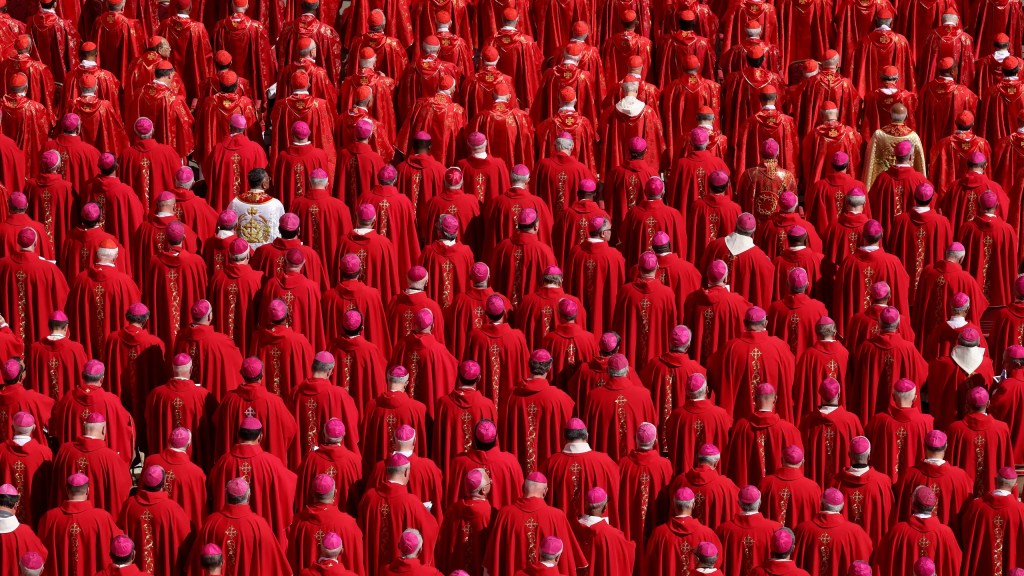
The worldwide focus on the aesthetics of the recent conclave, for example, even popular shows like the Young Pope really delving into and exploring the idea of the image, the power and draw of the image, of alienation from the image, of mystery and longing for the image, and in all these things particularly the image of the Church and her aesthetic tradition, but also of Christ and His vicar on earth. In short, there has been a heightened interest in beauty, including but not restricted to the sartorial – I am not sure what this tells us, but it is very noticeable – which suggests a spiritual draw beyond the mere performance of ritual.
Rebellion
Of course, we shouldn’t also rule out the possibility that an importasnt aspect of these trends might be that young men are attracted to the Church as a simple act of rebellion. Embracing the Faith is now a conscious act, and in many ways a deliberate act of resistance against the dominant secular ideologies of our time. For the first time perhaps since the Cold War worries of the 60s and 70s, public discourse is asking itself questions at the civilisational level, and there is a tangible fear that the old order has crumbled and the future looks far from certain. The political climate helps stoke up this fear that what we are dealing with – or what we are tasked with figuring out – is civilisational as much as political.
In this context then, the Catholic Church seems like something akin to the Ark, the bastion of stability, of clarity, of the preservation of wisdom and beauty that is otherwise decaying, a living link to a longed-for past – I do not think we can deny that nostalgia has a part to play in explainaing these trends. Sometimes that means a flight away, in disgust, or in anger – at other times it means the proactive decision to fight against it.
We see this in the wider cultural milieu, with prominent figures such as the high profile convert of Ayaan Hirsi Ali, a prominent atheist who converted to Catholicism, writing in her first article on the matter that she saw the Faith as the answer to the civilisational threat faced by the modern West, as much as it was a personal journey of faith. For Ali, the Church provided answers to the civilisational ennui that secular humanism just did not. Whilst we might point out that this seems an insufficient basis upon which to base one’s faith – and Ali later developed her thoughts to describe her personal faith journey – nonetheless it keys into something inchoate; that the Faith, its metaphysical foundations, and our understanding of salvation history all lend themselves well to the grand liturgy of Epic, to the death-and-glory narrative, the metaphysical battle between good and evil. It is no coincidence, after all, that Tolkien was a Catholic – or for a more scriptural foundation, ‘et portae inferi non praevalebunt adversus eam.’
Friendship
Lastly, and I think perhaps the most important: lots of young men simply appear to be looking for friendship. For example, one hears time and again that those who ahve turned up at the parish or the Catholic Society event are there for a simple reason: a friend asked them to come along. And when they are in, they find friendship, solidarity, camaraderie, and support. A safe space to be awkward, perhaps, in a world full of social risk.
What Now?
So what is the overarching theme to everything I have just said? Well, if I had to pick one, I would say people are looking for security: of tradition, of identity, of a defined role, of hierarchy, of beauty, of moral clarity, of consistency in spiritual development, and of honesty in helping them achieve it. In many ways they are simply looking for the Ark; they are looking for the Tabernacle.
Of course, this does present us with an opportunity to renew one of the Church’s most vital contributions to society: formation in service, honour, dignity, strength, and love. The Church has a unique and timely role to play in shaping a healthy, virtuous model of manhood rooted in Christ. These are not just individuals seeking personal meaning; they are potential leaders, husbands, fathers, and servants who can bring transformation to their families, communities, and professions. We should cherish them – but also help them grow in love and devotion, as we must all do. By doing this, the Church can both respond to spiritual hunger and in so doing witness to society as a whole. This is not just a pastoral challenge—it is a profound opportunity for renewal.
However, it does also bring its challenges.
First things first: some of those joining our communities are not coming from a place of religious heritage or gradual faith development (and that can be true even if they were baptised Catholic or even, I hate to say it, have come through a Catholic school). Instead, whilst some find themselves coming our way through curiosity, spiritual longing and sense of adventure, other drift toward us from experiences of alienation, personal struggle, and disillusionment. This vulnerability is both a spiritual opportunity and a pastoral challenge. The Church has a duty not only to welcome them, but to carefully and lovingly decode the beliefs, expectations, and baggage they bring with them—and then to transform those to life lived in and through Christ and His Church.
Which brings us to formation. For a good number, formation has chiefly been provided by YouTube and various figures within the rapidly blooming podcasting world. These figures offer something different, alluring even, often speaking the language of discipline and hierarchy, of reclaiming masculinity, of taking back control.
And, understood correctly, this is good.
But it is not without complications. To take one of the more popular figures, Jordan Peterson, while he is often respectful and even admiring of the Catholic tradition, he approaches it primarily as a psychologist and philosopher rather than with the eyes of faith. His explanations and expositiont are filtered through the lens of archetypes, myths, and symbolic interpretation—not the drama of salvation or the teachings of the Church. In other words, the formation he offers is psychological and reductionist, not sacramental or ecclesial. This matters, because it shapes the expectations of those who arrive at the Church’s door having first encountered her through Peterson’s lectures or similar thinkers. They may be prepared for challenge and tradition, but not necessarily for the humble, grace-filled demands of conversion – for sacrifice, but perhaps not always service.
Which brings us to perhaps a more troubling influence, which is that of the broader manosphere—a loosely defined but highly influential network of online personalities and communities that often speak to men’s frustrations with modern culture, particularly around dating, family, and gender roles. While some of these critiques can contain elements of truth, they are also too often shaped by cynicism, conflict, or an uncritical desire for dominance and control.
For those entering the Church shaped by these views, there is a real danger of misinterpreting the Faith as merely a conservative counterpoint to progressive excess—a bastion of “traditional values” in the culture war, rather than the mystical Body of Christ, called not to condemn the world but to redeem it. The Church is not the worldly empire domination of SPQR, as Elon Musk is fond of tweeting, but instead the spiritual kingship of Christi, crucified under the sign INRI.
Conclusion
If I was to be so bold as to try and put some of this into simple maxims, I would perhaps say the following: that many of those joining the Church want things that we have not always been terribly well set up to deliver. They want heroic service as a faithful disciple of the Church, not desacralised accounts of social justice and social work. They want challenge and rigour and the aspiration to holiness, not accompaniment and affirmation of their fallenness. They want the beautiful and the sacred, not the worldly and the profane. They want friendship and camaraderie in common endeavour, not just a sanctified replica of the world they have deemed insufficient to satiate their spiritual thirst. Finally, they want to be men: and they want to be cherished for the gifts they have to offer as men.
This renewed interest can be a great gift to the Church. It suggests that the Church, once thought irrelevant or weak, is regaining her “swagger”—a confidence in her teachings, her beauty, and her mission. But with this renewed attention comes responsibility. We must be ready not only to affirm what is good in these seekers’ desires, to mebrace their gifts and their dynamism and their energy and yes even their intensity, but also to challenge what is broken or misdirected. The Church must be a place where men do not simply find an alternative to the world they reject, but a home where they can be healed, re-formed, and sent out as disciples—not warriors of culture, but witnesses to Christ. That is a harder, slower, and more costly journey, and we may lose some along the way—but it is the one that leads to life. And in so doing, they will come to Christ – as with Tolkien, and in Him find their heroism:
I put before you the one great thing to love on earth: the Blessed Sacrament. . . . There you will find romance, glory, honour, fidelity, and the true way of all your loves on earth




 Outside In
Leave a comment