I do like a paradox – they’re useful little things. They can convey a great truth whilst appearing to demonstrate foolishness on the part of the one uttering it. This probably speaks to my vanity, or perhaps a small strain of contrarianism, but there is a certain divine beauty in the paradox – God, we are reminded, chooses what is foolish to shame the wise.
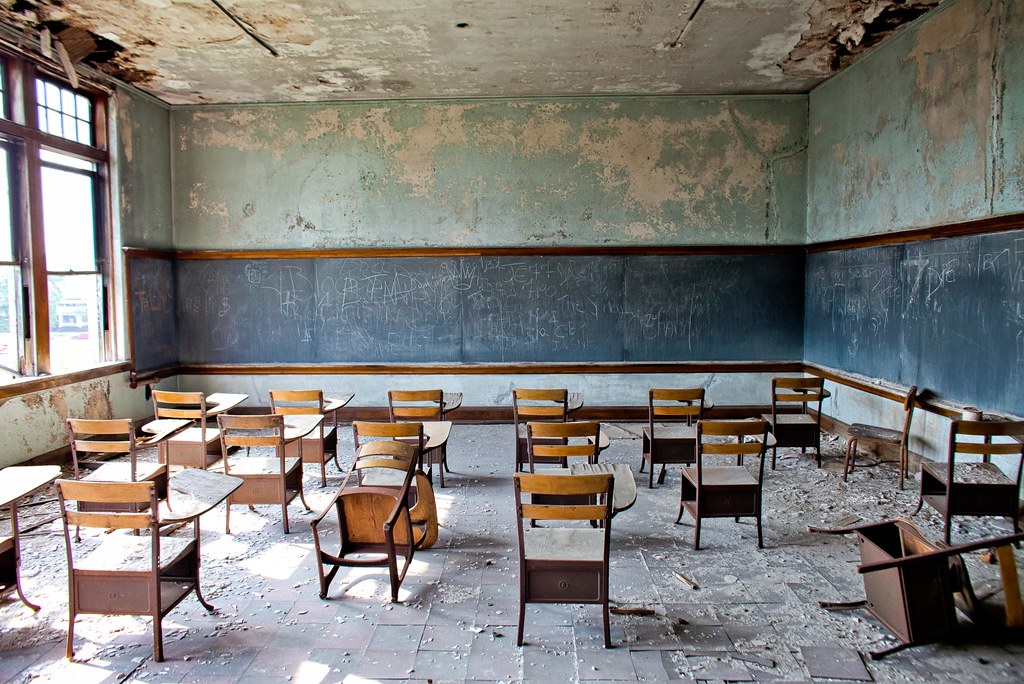
It is apt to call to mind, as it leads me to a paradox at the heart of public life today. In short: we no longer care about education. We spend more than we ever have on education, we have embedded it at the heart of our culture, and our employment markets, we have woven it into our sense of status, and achievement, and virtue, made it the gatekeeper for social advancement and access, and allocated vast amounts of resource and emotional labour to its maintenance and delivery and successful consumption.
And yet, at the same time, we have rarely cared so little about it.
To unpack the claim above, let’s be clear – the technocratic endeavour has never been so prominent. By pretty much any metric we might care to use, we have never been more education-focussed. It is a permanent fixture of the political grid, a top-three spending priority currently swallowing up nearly £120 billion per year, and a continual source of material for ministers wishing to demonstrate their commitment to social justice and the plight of the poor. We have more data, more metrics, and more ‘best practice’ toolkits than at any point in our history, and whole industries that have grown up to service and support this behemoth – be that personnel, or recruitment, or curriculum resource, or training, or professional development, or estates, or health, or SEND, or alternative provision, or finance.
Yet, whilst gladly granting all this, the point holds: as a culture we have stopped talking about education – in its missional sense – almost entirely.
What might we call this – a blind spot? The weariness of familiarity? One is tempted to reach for the whole Dark Ages thing, but maybe that is too obvious – I have written before about the encroaching age of the philistine. Still, while we have become really quite expert at the operations of the system, the actual soul of the enterprise has rarely been so ill-attended.
Instead, we have franchised out fundamental questions to the system itself – and to those who inhabit it – wresting any vision for the formation of our children away from the commons and the (educational) outsiders who reside there. Instead, the educational clerisy is tasked not only with delivering a system, but with deciding upon its purpose too. In short, fundamental questions of meaning, of the values we wish to inculcate and the stories we wish to preserve, have been wrenched free of the amateurs and the interested and handed only to those professionals whose livelihoods depend on the endeavour.
The bigger questions – what is a school for? whom does it serve? what constitutes a well-ordered mind? what is our duty to the past? – have been banished from view. In their place, a technocratic everythingism profoundly lacking in intellectual energy.
We have to force ourselves to remember that it wasn’t always this way. Education was once considered far too important to be left to the experts; certainly too important to let politicians too close. No, education was seen as a common endeavour, a collective good that brought in parent, parson, and public intellectual alike. This was not overreach, and there was no sense of anybody having to stay in their lane – quite the opposite; as education was emerging as a social good to which the State must be a faithful partner, so it behoved people of good will to enter the fray.
Individual improvement, social progress, the formation of the intellect, the shaping of the soul, the transmission of culture, the bequeathing of a cultural heritage, the induction into a particular identity and social role – all of this shaped thinking and found voice in vibrant wider debates about education.
As such, thinkers as diverse as T.S. Eliot, G.K. Chesterton, Charlotte Mason, John Ruskin, Winston Churchill, R H Tawney, Christopher Dawson, John Henry Newman, Hannah Arendt, Matthew Arnold, Maria Montessori, George Lansbury, Margaret McMillan, Bertrand Russell, Don Bosco, John Dewey, and Michael Oakeshott viewed education as a civilisational and civilising mission. When they wrote about education – and about schools – they weren’t just debating the mechanics and the minutiae (although they were often interested in this too); rather, they were enervated by the social and moral dynamic that always comes prior to any discussion about pedagogy. In other words, it was axiomatic that education was about weightier matters than mere politics; it was about the soul, of the individual as much as wider society, such that everyone – amateur or otherwise – had justification to take a view on it and everyone had cause to be involved.
Today, that calibre of voice – that level of wider interest – is missing. The poet, the philosopher, the parent – all replaced by the policy wonk and the educationalist. If a modern-day Eliot tried to weigh in on the transmission of culture, or an Oakeshott should share his view on the languages of learning, or a Charlotte Mason were to write on high culture, or a Don Bosco on the relationality of learning, they would be dismissed – were they to pick up their pen at all – as well-meaning amateurs that should step aside and leave it to the experts.
Professionalising the debate like this – or rather, hiding it within the lecture hall and zoom meetings of the gradclass that exist to deliver it – has sterilised it. Something that was a profoundly democratic undertaking has become a technocratic one, a narrowing that has led to a values and expectations-chasm between teacher and taught, a distancing showing itself in the culture clashes hitting our schools.
By doing this, we have chased away new ideas about schooling that could shape a system more attuned to wider conceptions of excellence and service. The big ideas have gone away – indeed, we could plausibly argue the last great social debate about education was the reckoning with the grammar school system in the 60s and 70s. Now, it is more akin to a series of internal HR disputes, endless minutiae about pedagogical effectiveness, and some fairly mild tinkering with funding structures.
Even the Gove moment, for all it talked up its revolutionary fervour with appeal to the ‘blob’ it sought to vanquish, amounted to little more than a change in accountability lines; the rest of the values infrastructure remained more or less intact, and indeed in many ways accelerated, with Gove proudly proclaiming his vision of education as the vehicle for social justice.
The result has been a largely homogenous system – in culture and values – locking out diversity whilst centralising power structures that are outright hostile to any other players in the market, including parents themselves. If you take your kid on holiday, you’re getting fined, if you home school you’re getting inspected, and if you opt out of state provision and look for independent then a punishment tax is on its way to you – and all because the State cares about your kid more than you do. This – we are to believe – is the meaning of high standards: that the State will decide, and the State will provide, and all else is regression from the ideal.
And so, we have a system whose main job is ensuring compliance with central-writ, the chief aim of which seems to be rule out any alternative to itself, a greater tragedy since there are now so vanishingly few voices articulating what that alternative might be. Even deviations from the norm – Katharine Birbalsingh’s Michaela School, for example, or Peter Hyman’s School 21 – are notable by their rarity, but also their lack of signal and replication across the wider system.
And people have responded accordingly – home schooling is now at 150,000 children a year. For the average parent, there is no lever to pull if they disagree with the underlying philosophy of education, no huge range of choice within the system – and not much space within the legal or funding infrastructure of the education sector to do things much differently. The free school movement might have been an opportunity, however the outcome was (largely, not universally) often just the provision of a high-rigour vision of schooling exceptional for its lack of wider availability rather than its inherent distinctiveness as an educational philosophy.
So the challenge comes forth: why do so few people seem to care about education? Why – outside of the education sector – have we lost interest? Where are the voices – in the politics, the arts, the culture – rolling up their sleeves and entering the arena, helping us decide what this vital project should look like?
And that same challenge can be directed at the political class, too. Be that Labour, whose insights into education seem to penetrate no deeper than its use as a prop for the welfare system; the Tories, whose wider analysis seems reluctant to consider anything weightier than whether or not children should have mobile phones in schools; or the Lib Dems, Greens or Reform, who seem at this point to have nothing of substance to say at all. They need to do better – uttering platitudes about breakfast clubs or the latest Treasury funding-round is not quite enough; what we are discussing is much bigger, much more important, than just that.
Because it seems evident that our thinking about education – this thing so noble, that energised the mind of so many great thinkers past – has become alienated from a sense of common endeavour, of the common good. Education is no longer a collective effort to which we must contribute, but is instead a service to be passively consumed with increasingly little discussion about what it should look like or who should decide what it should look like.
If we think education is of primary importance, that its function is not only individual but civilisational, then this is not sustainable. And if James Marriott is correct that the retreat from reading is the collapse of culture, that we have entered a post-literate age, then I would add that this signals a wider malaise which is indifference toward education per se. And with it, surrounded by the fruits of unimaginable technological progress and material development, is signalled our demise – God does indeed make fools of the wise.


 Outside In
Leave a comment